
When we list the causes of LC discrepancies, the origin document always ranks near the top. The reason is simple: the exporter does not produce it alone. A chamber, customs and sometimes a consulate are involved, and every extra hand adds time and room for error. On top of that, an origin document of the wrong type can create a contradiction inside the credit itself.
This guide is written from the perspective of goods exported from Turkey, which is where most of our transactions originate. The document types below are those used in Turkish exports; buyers importing from Turkey will meet the same documents.
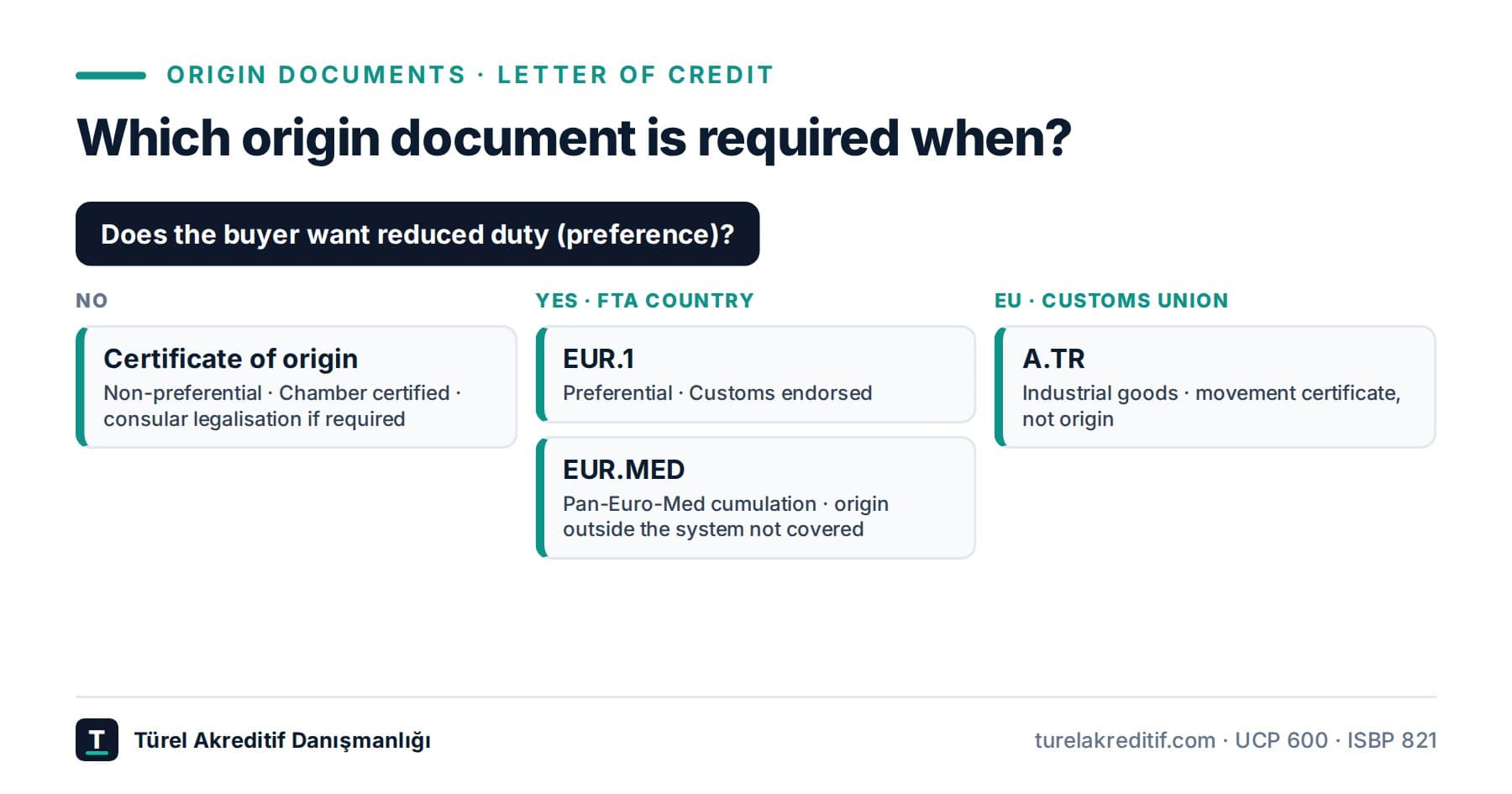
Four documents, four purposes
Certificate of origin
The general (non-preferential) origin document showing where the goods were produced. It gives no customs duty reduction; it is required by the importing country's rules, for quotas or statistics, or simply by the buyer. In Turkey it is certified by chambers of commerce and industry.
It is the origin document most often required under letters of credit. Some markets also require consular or embassy legalisation on top.
EUR.1 movement certificate
A preferential origin document: for exports to countries with which Turkey has a free trade agreement, it shows the goods meet the agreement's origin rules and lets the buyer import at a reduced or zero duty. It is endorsed by customs.
EUR.MED movement certificate
A preferential origin document used between countries in the Pan-Euro-Mediterranean system of cumulation of origin. Cumulation allows goods made with inputs from several participating countries to obtain preferential origin.
The key point: EUR.MED only covers origin from countries inside the system. EUR.MED cannot be issued for goods originating in a country outside it.
A.TR movement certificate
Under the Customs Union between Turkey and the EU, it shows that industrial goods are in free circulation. Technically it is not an origin document but a movement certificate: it proves free circulation, not that the goods were produced in Turkey.
For shipments below certain values, or for approved exporters, preferential origin can also be shown by an origin declaration on the invoice instead of EUR.1 or EUR.MED. If the credit allows it, your document burden is lighter.
Four origin-document traps under a letter of credit
1. The credit's origin wording conflicts with the document required
In our Tunisia case study, the credit referred to goods of Turkish origin, the additional conditions (47A) mentioned "Turkey – South Korea" origin, and at the same time EUR.MED was required as a mandatory document. Goods of South Korean origin are not covered by EUR.MED, so the document contradicted the credit's own origin wording. Had it been presented, a discrepancy was almost certain. Because it was spotted at draft stage, a single amendment request solved it.
Prevention: Put the credit's origin wording, the type of document required and the actual origin of the goods side by side. If all three don't say the same thing, have the text corrected before you accept it.
2. Multi-origin declarations
Some buyers want the origin of every component shown separately on the document. In our Libya case study, the certificate of origin had to declare six different countries of origin. A single missing country, or one conflicting with the invoice, is a discrepancy.
Prevention: Prepare the origin list in advance together with your supplier documents, and ask the chamber whether it will certify in that format.
3. The certification chain eats your time
Chamber certification can take a few days; add consular legalisation and it takes much longer. If the presentation period is 21 days, or shorter, the certification chain can use it up.
Prevention: If a document needs certification, ask for a presentation period that allows for it at draft stage. For the timing rules, see LC deadlines.
4. Unclear who issues the document
If the credit calls for a "certificate of origin" without stating the issuer, it may be issued by any party, including the beneficiary; the bank checks that it appears to fulfil its function and does not conflict with other documents (UCP 600 art. 14f and ISBP 821). But if the credit says "issued by chamber of commerce" or "legalized by embassy", that condition must be met exactly.
Prevention: If the credit names an issuer and certifying authority, check that this is actually possible in the exporting country. For example, a requirement that a preferential document (EUR.1) be "issued by the chamber of commerce" may not match practice in Turkey, where customs endorses it.
Consistency with the other documents
The origin document must not conflict with the other documents. The most common conflicts:
- The goods description does not match the invoice (a general description is acceptable on the origin document, a conflicting one is not).
- Package count or weight differs from the packing list or bill of lading.
- Exporter and buyer details differ from the credit.
- The country of origin differs from the origin wording in the credit.
Summary
- A certificate of origin is non-preferential; EUR.1 and EUR.MED are preferential; A.TR is a Customs Union movement certificate.
- EUR.MED only covers origin from countries inside the Pan-Euro-Mediterranean system.
- The credit's origin wording, the document type and the real origin must all say the same thing.
- The certification chain can use up the presentation period; ask for enough time at draft stage.
- Most origin problems are solved at the text stage. Our LC text review does this check before you accept.
Does your credit require an origin document or legalisation? Send it for a free preliminary review and see the surprises before presentation.