
A discrepancy is a point where the documents presented do not meet the terms of the credit. When the bank finds one, it is released from its obligation to pay and the decision passes to the buyer. The buyer may waive the discrepancy, or turn it into a price negotiation.
The good news: most discrepancies come from the same mistakes every time. The ten causes below are the discrepancies banks raise most often, each with a practical fix. We covered the overall approach in how to prevent LC discrepancies; this article is the list itself.
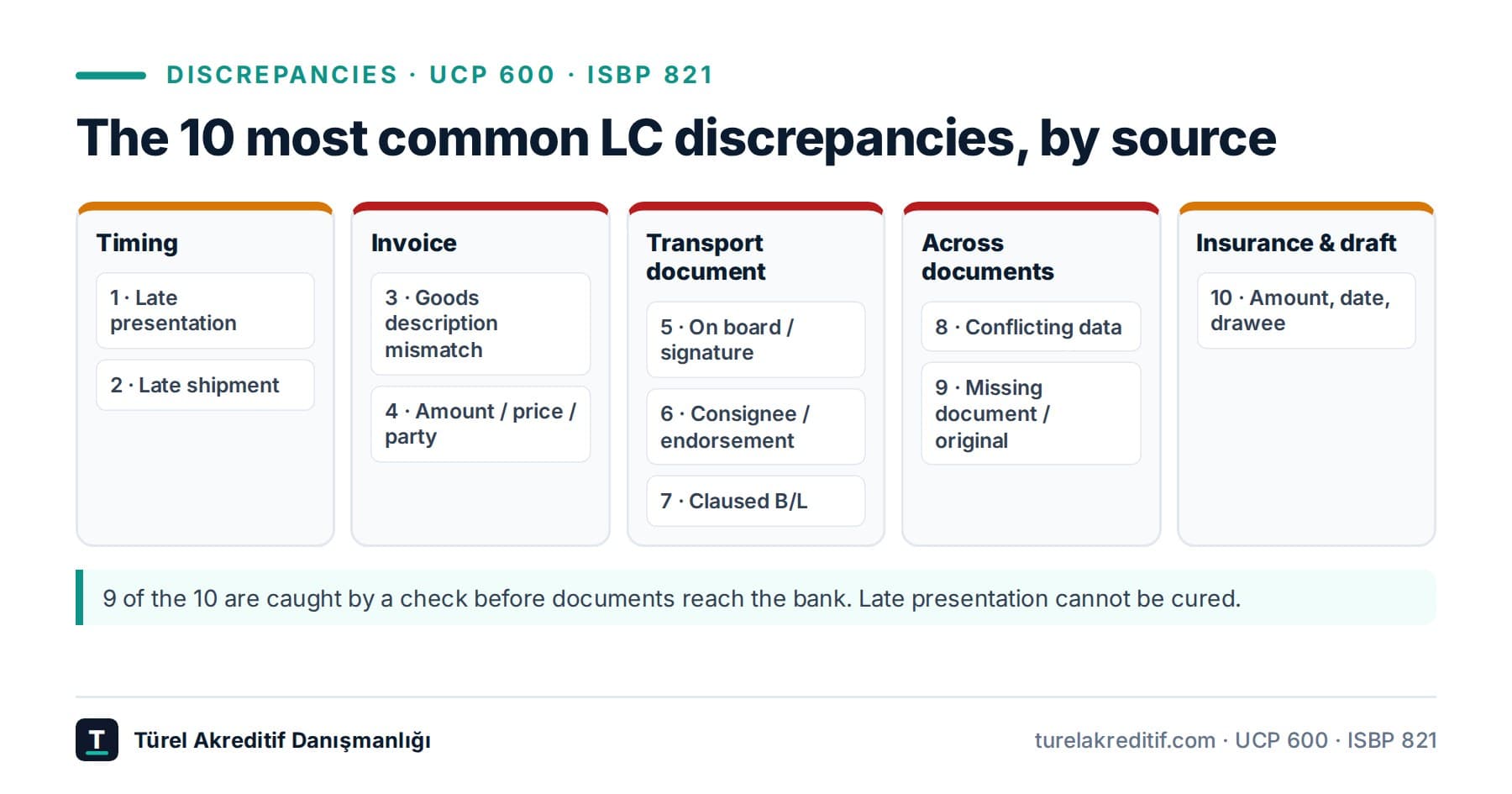
Timing discrepancies
1. Late presentation
Documents were presented after the presentation period (field 48, or 21 days after shipment if not stated) or after the expiry date. This is the one discrepancy that cannot be cured: you can reissue a document, but you cannot turn back the clock.
Prevention: Work out the last day for presentation on the day you ship, and don't leave documents to the last day. Details in LC deadlines.
2. Late shipment
The bill of lading date is after the latest shipment date (44C). There is no extension for holidays.
Prevention: Plan the vessel and container delivery a few days before the latest shipment date. If a delay is unavoidable, request the extension before shipment.
Invoice discrepancies
3. Goods description does not match the credit
The description of goods on the commercial invoice must correspond with the credit (45A) (UCP 600 art. 18). A missing word, a different model code or different delivery terms are all discrepancies.
Prevention: Copy the description from 45A word for word; if more detail is needed, add it after the description, not instead of it.
4. Amount, unit price or invoice party errors
The invoice exceeds the credit amount, shows a different unit price, or is not made out to the applicant (the buyer).
Prevention: Check the invoice amount, the tolerance (39A) and partial shipments together. The invoice must be in the buyer's name and in the currency of the credit.
Transport document discrepancies
5. On-board or signature problems on the bill of lading
The bill of lading does not show the goods were shipped on board, does not name the carrier, or does not indicate the capacity of the signatory (carrier, master or an agent for either) (UCP 600 art. 20).
Prevention: When you receive the draft B/L from the carrier, compare the signature block and "shipped on board" wording with the credit. A correction at draft stage is free; after issue, it is not.
6. Consignee, notify party or endorsement errors
The credit says "to order of issuing bank" but the B/L is consigned to the buyer; or an order B/L has not been endorsed. This is not only a discrepancy, it can also cost you control of the goods.
Prevention: Pass the B/L instructions in 46A to your forwarder in writing and word for word.
7. Claused (unclean) bill of lading
The B/L carries a notation declaring the goods or packaging defective, such as "packaging damaged". Under UCP 600 article 27, banks only accept clean transport documents.
Prevention: If something at loading would lead to a damage notation, resolve it before the B/L is issued.
Cross-document discrepancies
8. Documents conflict with each other
Gross weight on the invoice differs from the packing list, the number of packages on the packing list differs from the B/L, or the port of loading differs on the origin document. Under UCP 600 article 14(d), data need not be identical but must not conflict.
Prevention: Produce all documents from a single data source (for example a shipment summary sheet). Filling in each document by hand separately is the main cause of conflicts.
9. Missing document or missing originals
A document required in 46A was not presented, or two originals were presented where three were required.
Prevention: Turn 46A into a checklist and tick off each document with the required number of originals and signature conditions.
Insurance and draft discrepancies
10. Insurance document or draft errors
The insured amount is too low (if not stated, at least 110% of the CIF or CIP value), the insurance is dated after shipment, or it is in a different currency (UCP 600 art. 28). Where a draft is required, a wrong drawee or different amounts in words and figures are common.
Prevention: On CIF/CIP sales, arrange insurance before shipment with the correct amount and cover. Draw the draft in line with fields 42C and 42a of the credit.
The common thread: discrepancies are born in preparation
Nine of these ten causes can be caught by a check made before documents go to the bank. The remaining one (late presentation) is a planning problem in the first place.
A practical method:
- Review the credit before accepting it and have unworkable terms corrected at draft stage. See the LC draft checklist.
- Produce all documents from a single data source.
- Before presentation, check documents against the credit and against each other.
Our pre-presentation document check handles that third step. If the bank asks for corrections, we follow up the re-presentation too.
Summary
- Most discrepancies come from the same ten mistakes: timing, invoice, bill of lading, conflicting data, missing documents, insurance and drafts.
- Late presentation is the one discrepancy that cannot be cured.
- The goods description should be copied from 45A word for word.
- Documents need not be identical but must not conflict (UCP 600 art. 14d).
- Discrepancies appear at presentation, but they are prevented in preparation.
About to present a set of documents? Write to us and we will check them together before they go to the bank.