
Before the credit is issued, your buyer may send you a draft. Or the buyer's bank issues it and the advising bank passes it on. Either way, that text is the complete list of conditions you must meet to get paid. The moment you accept it, every condition in it binds you.
Most discrepancies show up at presentation, but they are born in the credit text. That is why the cheapest and most effective check is made while the credit is still a draft. Changing an issued credit means an amendment: time and fees.
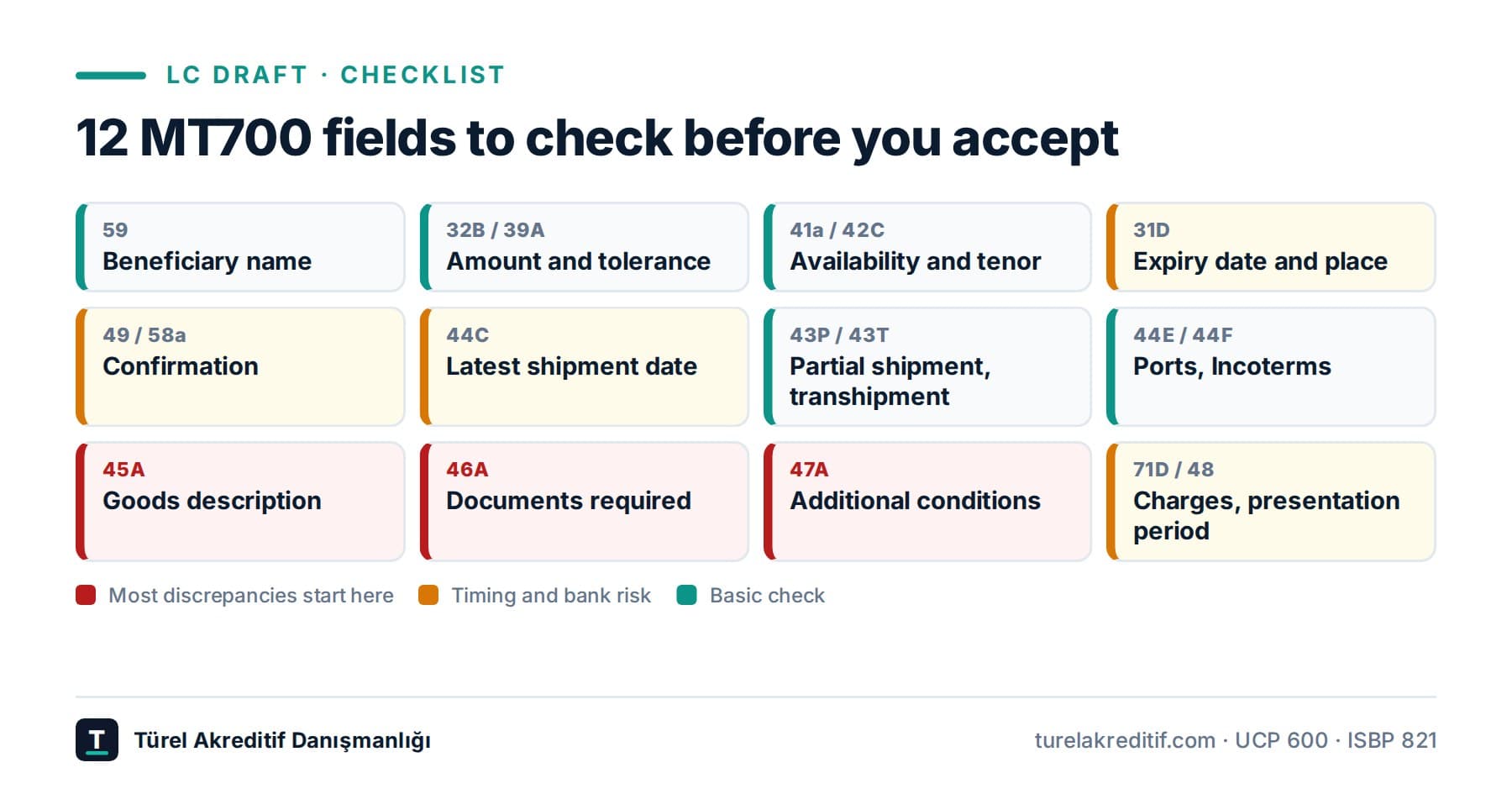
The 12 questions below summarise the check to make before accepting, using the SWIFT MT700 fields.
Parties and amount
1. Is your name correct? (59: Beneficiary)
Is your company name exactly as registered? If the name on your documents conflicts with the credit, you risk a discrepancy. UCP 600 article 14(j) is more flexible on addresses, but take no risk with the name.
2. Are the amount, currency and tolerance right? (32B, 39A)
Does the amount match the proforma invoice? If you sell bulk or weight-based goods, is there a tolerance in 39A (for example 10/10)? Without it, you fall back on the limited tolerance of UCP 600 article 30.
Payment structure
3. Where and how is the credit available? (41a, 42C)
"Available with ANY BANK by NEGOTIATION" and "available with ISSUING BANK by PAYMENT" are very different. In the second, nothing happens until your documents reach the issuing bank abroad. For deferred payment, the maturity basis (bill of lading date or presentation) must be clear.
4. Are the expiry date and place realistic? (31D)
If the place of expiry is the buyer's country, documents must reach it by that date. Where possible, ask for expiry in your own country.
5. Is there confirmation, and do you need it? (49, 58a)
If the issuing bank is weak, does the credit carry confirmation instructions? "CONFIRM" alone is not enough; you must see in the advice letter that confirmation was actually added. See confirmed letter of credit.
Shipment
6. Does the latest shipment date fit your production and freight plan? (44C)
Allow for production, container availability, customs and the vessel schedule. The latest shipment date is not extended for holidays (UCP 600 art. 29c).
7. Are the ports right? Are partial shipments and transhipment allowed? (44E, 44F, 43P, 43T)
Port names will be copied onto the bill of lading. If transhipment is prohibited on a route without a direct service, you may be unable to produce a compliant bill of lading. If containers might sail on different vessels, partial shipments must be allowed.
8. Do the delivery terms match the sales contract?
Is the Incoterms rule in the credit (FOB, CFR, CIF...) the same as in the contract? A CIF credit calls for an insurance document; a CFR credit does not. A mismatch is both a cost and a document problem.
Goods and documents
9. Can the goods description go onto your invoice word for word? (45A)
The description on the commercial invoice must correspond with the description in the credit (UCP 600 art. 18). If 45A contains unnecessary technical detail, a model number, or wording different from what you actually produce, fix it now.
10. Can you produce every document required? (46A)
Go through the document list line by line and ask: who will issue this document, and can they issue it exactly as required? Watch in particular for:
- Documents to be signed by the buyer or its agent (inspection or acceptance certificates). These make your payment depend on the buyer's goodwill.
- Documents requiring consular legalisation or a specific chamber's certification.
- The type of origin document requested, and whether your goods qualify for it.
- Numbers of originals and copies ("in 3 originals and 3 copies").
11. Are there traps in the additional conditions? (47A)
47A is where problems hide. Look for clauses that are unworkable, vague, or that let the buyer block payment: "documents subject to applicant's approval", "vessel not older than 15 years" (if a document must prove it, who issues it?), "quality to buyer's satisfaction".
Charges and presentation period
12. Are charges and the presentation period clear? (71D, 48)
71D should say who pays charges outside the issuing country, the confirmation fee and discrepancy fees. Is the presentation period in field 48 long enough to gather your documents and present them? If none is stated, 21 days after shipment applies.
What to do when you find a problem
If you are still at draft stage, send the buyer one written, reasoned list of corrections. If the credit is already issued, request an amendment with the same list. Piecemeal amendments cost fees and time. Our Libya case study shows how amendment traffic was brought under control.
And remember: under UCP 600 article 10, no amendment is effective without your consent. You are not obliged to accept a change that works against you.
Summary
- A correction made at draft stage is far cheaper than a discrepancy at presentation.
- The critical fields: 45A goods, 46A documents, 47A additional conditions, 44C latest shipment, 31D place of expiry, 49 confirmation.
- For every document, ask "who will issue this?"
- Documents signed by the buyer put your payment in the buyer's hands.
- Collect all corrections in a single list.
You can run this check with your own team on every credit. If you have a text you are unsure about, our LC text review is built for exactly this. For the rules behind these fields, see UCP 600 explained.
Have a draft credit in hand? Send it for a free preliminary review and we will flag the risky clauses before you accept.