
"The buyer has opened a letter of credit, so my money is safe." It is the most common assumption exporters make. But a letter of credit is the undertaking of the bank that issued it. If that bank cannot pay, if transfers out of the country stop, or if a political crisis hits, your money can be delayed even when your documents are perfect.
The strongest tool against that risk is confirmation.
What is confirmation?
Confirmation is a second bank (usually in the exporter's country, or a strong international bank) giving its own undertaking to pay, in addition to and independently of the issuing bank.
Under UCP 600 article 8, the confirming bank must honour when complying documents are presented to it or to a bank it has nominated. That obligation does not depend on whether the issuing bank pays. Collecting from the issuing bank afterwards is the confirming bank's problem, not yours.
In short, confirmation moves the payment risk from a weak issuing bank to a strong confirming bank.
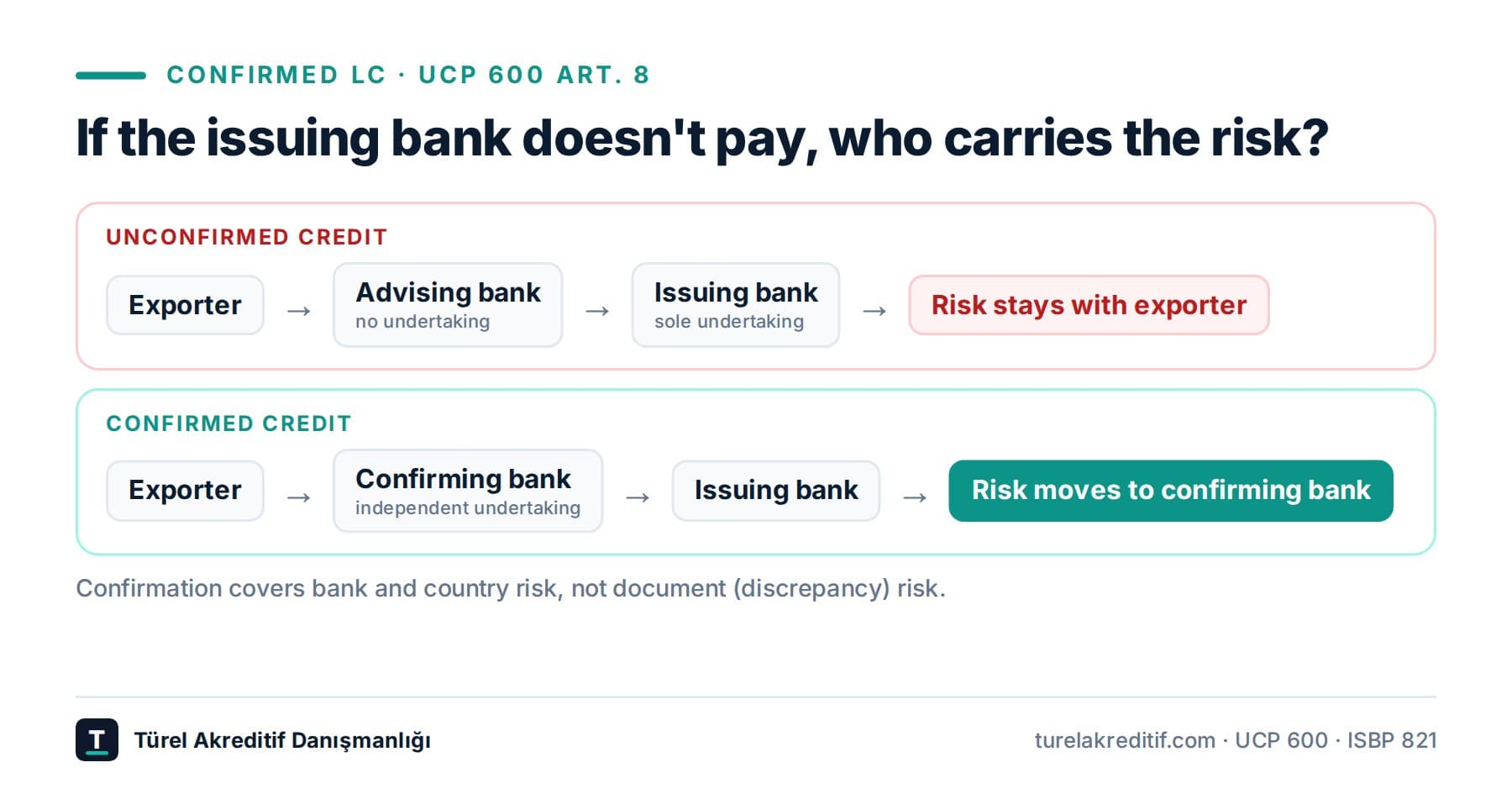
Unconfirmed versus confirmed
In an unconfirmed credit, the bank in your country is usually only the advising bank. It checks that the credit is authentic and passes it on; it gives no undertaking to pay (art. 9). When you present documents, it forwards them to the issuing bank and waits. If the issuing bank does not pay, or pays late, you are the one left waiting.
In a confirmed credit, you are entitled to payment from the confirming bank as soon as you make a complying presentation. Transfer restrictions, currency shortages or bank risk in the issuing country do not affect you directly.
An important detail: confirmation does not remove document risk. The confirming bank also examines documents under UCP 600 article 14. If they are discrepant, it can refuse too. Confirmation protects you against bank and country risk, not against discrepancies. We cover how to avoid those in how to prevent LC discrepancies.
How confirmation appears in the credit
In a SWIFT MT700, confirmation instructions sit in field 49. It takes one of three values:
- CONFIRM: The issuing bank asks the advising bank (or a named bank) to add its confirmation.
- MAY ADD: The issuing bank authorises confirmation; whether it is added depends on the beneficiary's request and the confirming bank's decision.
- WITHOUT: Confirmation is neither requested nor authorised.
Be careful: "CONFIRM" in field 49 does not mean the credit is confirmed. The requested bank has to accept. Under UCP 600 article 8(d), a bank that does not wish to add its confirmation must tell the issuing bank without delay, and may still advise the credit without confirmation.
This is a trap we see often: the credit requests confirmation, the buyer says "we opened a confirmed LC", but the bank in the exporter's country advises it unconfirmed. If the exporter does not read the advice letter carefully, they find out after shipment. Our Tunisia case study shows how this was caught before shipment.
Who pays for confirmation?
Confirmation is not free. The confirming bank charges a fee based on the risk of the issuing bank and its country. In high-risk countries the fee rises sharply, and some banks will not confirm at all.
Who bears the fee is set in field 71D (Charges). Credits very often put all charges outside the issuing bank's country on the beneficiary, which means the confirmation fee is yours. So:
- Build the confirmation fee into your price from the start, or
- Have the sales contract and the credit state clearly that it is for the buyer's account.
- Ask your bank for a confirmation quote on that issuing bank before you quote your buyer.
When is confirmation essential?
Not every credit needs confirmation. Confirming a credit issued by a strong bank in a stable market is usually an unnecessary cost. Take confirmation seriously when:
- The issuing bank has a weak credit rating or is unknown to you.
- The buyer's country has currency controls or transfer problems.
- There is political instability, sanctions exposure or conflict risk.
- The amount is larger than a loss your business could absorb.
- It is a deferred-payment credit; the longer the term, the more time something can go wrong at the issuing bank.
A practical rule: if you cannot afford your money being delayed when something goes wrong in the buyer's country, get confirmation.
What if no bank will confirm?
For some issuing banks, no bank will confirm. That is the clearest possible warning sign. Your options are then:
- Ask for the credit to be issued by another bank (for example the buyer's bank in a third country).
- Increase the advance payment.
- Split the amount and keep the first shipment small.
- Accept the risk knowingly and price it in.
Whatever you choose, decide before accepting the credit. Once goods are shipped, your negotiating power is gone.
Is confirmation available from a bank's point of view, what will it cost, and how should the credit be structured? Our confirmation analysis answers those questions while the deal is being set up. The LC draft checklist covers the other fields to check before you accept.
Summary
- Confirmation is a second bank's undertaking to pay, independent of the issuing bank (UCP 600 art. 8).
- It protects against bank and country risk, not against discrepancies.
- "CONFIRM" in field 49 is not enough; check the advice letter to see confirmation was actually added.
- If 71D is silent or puts foreign charges on you, the confirmation fee is usually yours.
- Consider confirmation seriously with a weak bank, currency controls, a large amount or a long tenor.
Not sure whether a credit in your favour needs confirmation? Ask for a free preliminary review and settle it before shipment.