
Many of the markets exporters want to grow in are also markets where payment risk is high: countries with currency controls, delayed transfers, a weak banking system or ongoing political uncertainty. Buyers there rarely pay in advance, and the exporter cannot take open-account risk. That is why the letter of credit is the most common solution.
But in a high-risk market, a letter of credit is not security on its own. A credit is only as strong as the bank that issues it and the country that bank sits in.
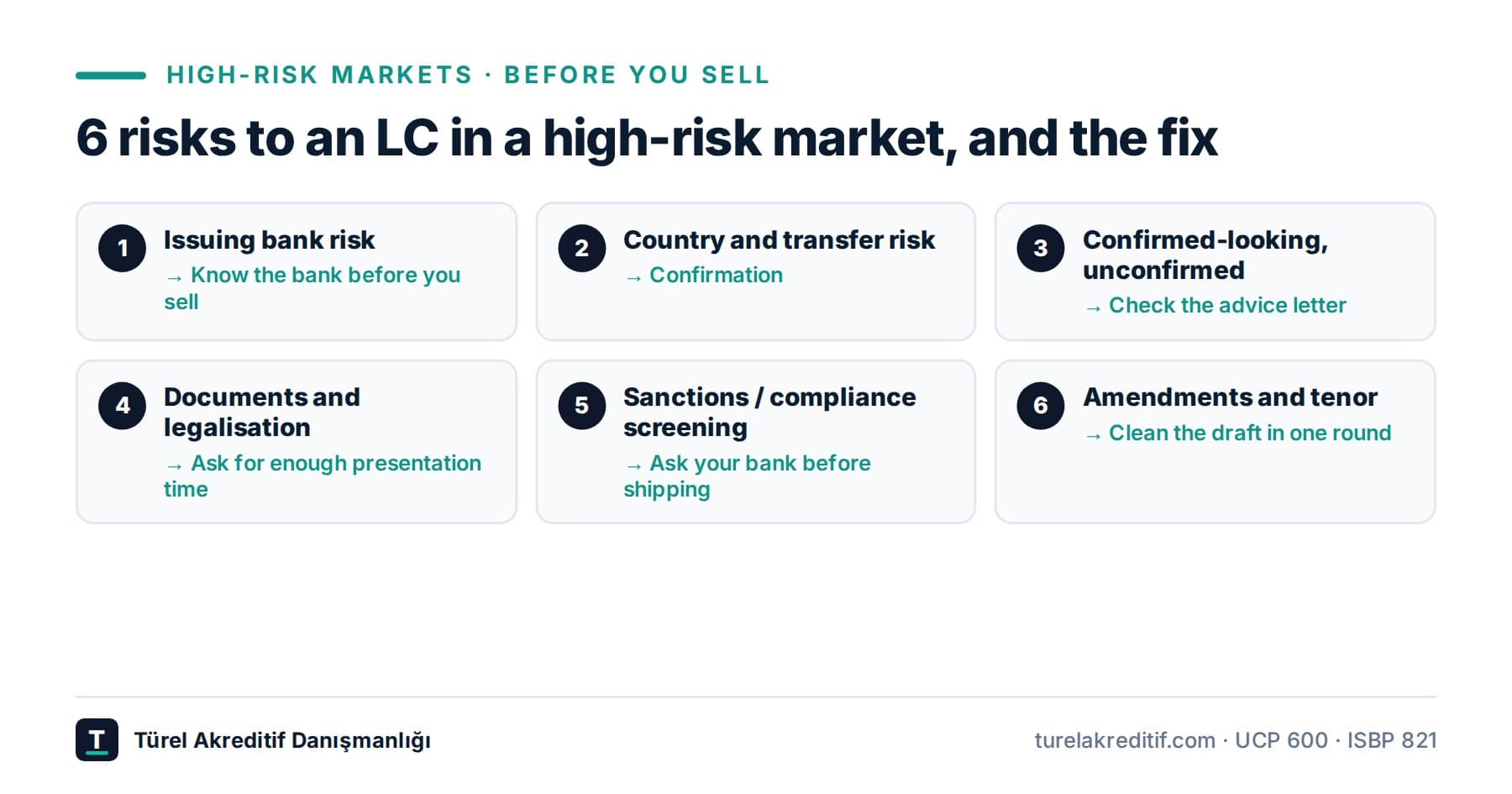
1. Issuing bank risk
The undertaking to pay comes from the issuing bank (UCP 600 art. 7). If that bank is financially weak, payment can be delayed even when your documents are perfect.
What to do: Find out the name of the issuing bank before you sign the sales contract and talk to your own bank: do they work with this bank, and will they confirm? If no bank will confirm, that is the clearest warning sign there is.
2. Country and transfer risk
Even with a sound issuing bank, currency controls or transfer restrictions can stop the money leaving the country. That risk is outside the bank's control.
What to do: Only confirmation carries this risk. The confirming bank undertakes to pay independently of the issuing bank and its country (UCP 600 art. 8). In a high-risk market, an unconfirmed credit leaves the risk with you, not with a bank. More in confirmed letter of credit.
3. The "confirmed-looking" unconfirmed credit
The credit may carry a confirmation instruction (49: CONFIRM), but that does not mean confirmation was actually added. If the bank in your country does not want the risk, it advises the credit unconfirmed.
That is exactly what happened in our Tunisia case study: the credit requested confirmation and even named the confirming bank, but it was advised unconfirmed. Because this was spotted before the text was accepted, it was fixed with a correction request.
What to do: Do not start shipping until the advice letter shows in writing that confirmation has been added.
4. Document and legalisation burden
In some markets, credits carry heavy document requirements: certificates of origin legalised by a consulate or embassy, chamber certification, specific wording to be added or removed, multi-origin declarations. Every extra condition adds cost, time and discrepancy risk.
In our Libya case study, the certificate of origin had to declare several countries of origin, drop a vague word, and be certified by both the chamber of commerce and the consulate. That single document caused most of the amendments after issuance.
What to do: For every document that needs certification, ask at draft stage: "who issues it, who certifies it, how many days does it take?" and ask for a presentation period that allows for it. For origin documents in detail, see certificates of origin under a letter of credit.
5. Sanctions and compliance risk
Banks screen against sanctions lists and high-risk jurisdictions. If a party, the vessel, a port or the goods themselves are caught by that screening, the bank can stop the transaction or refuse to handle it at all. The credit being subject to UCP 600 does not protect you here.
What to do: Share the buyer, destination port, vessel and product with your bank before you sell, and ask whether they will handle the deal. A "no" before shipment is far cheaper than a "no" after.
6. Amendment traffic and tenor risk
In high-risk markets, credits change often after issuance. Every amendment means fees, correspondence and a new time window. With deferred credits, issuing bank and country risk continue throughout the term.
What to do: Clean the text at draft stage with a single list of corrections. For deferred credits, keep the tenor as short as possible and tied to the bill of lading date; a long tenor with a weak bank calls for confirmation. See deferred payment letter of credit.
Short checklist before you sell
- Who is the issuing bank, will my bank confirm, and at what cost?
- Are there currency or transfer restrictions in the country?
- Which documents require certification, and how long will it take?
- Will the parties, vessel and product clear the bank's compliance screening?
- How long is the tenor, and what is it tied to?
- Are confirmation, legalisation and amendment costs included in the price?
Summary
- In a high-risk market, a credit is only as strong as the issuing bank and its country.
- Country and transfer risk can only be carried by confirmation.
- A confirmation instruction in the text is not enough; see it confirmed in the advice letter.
- Legalisation burden and amendment traffic are the most common causes of delay in these markets.
- Clear sanctions screening with your bank before shipment.
To run these checks while the deal is being set up, see our confirmation analysis.
Selling into a high-risk market on LC terms for the first time? Send the text for a free preliminary review and let's see the risks before you ship.