
Buyers increasingly ask: "We'll open a letter of credit, but make it 90 days." That lets the buyer sell the goods and collect the money before paying. For the exporter, the bank's undertaking remains, but the money arrives later and issuing bank risk runs for the whole term.
Structuring a deferred credit correctly decides both your cash flow and the security of your payment.
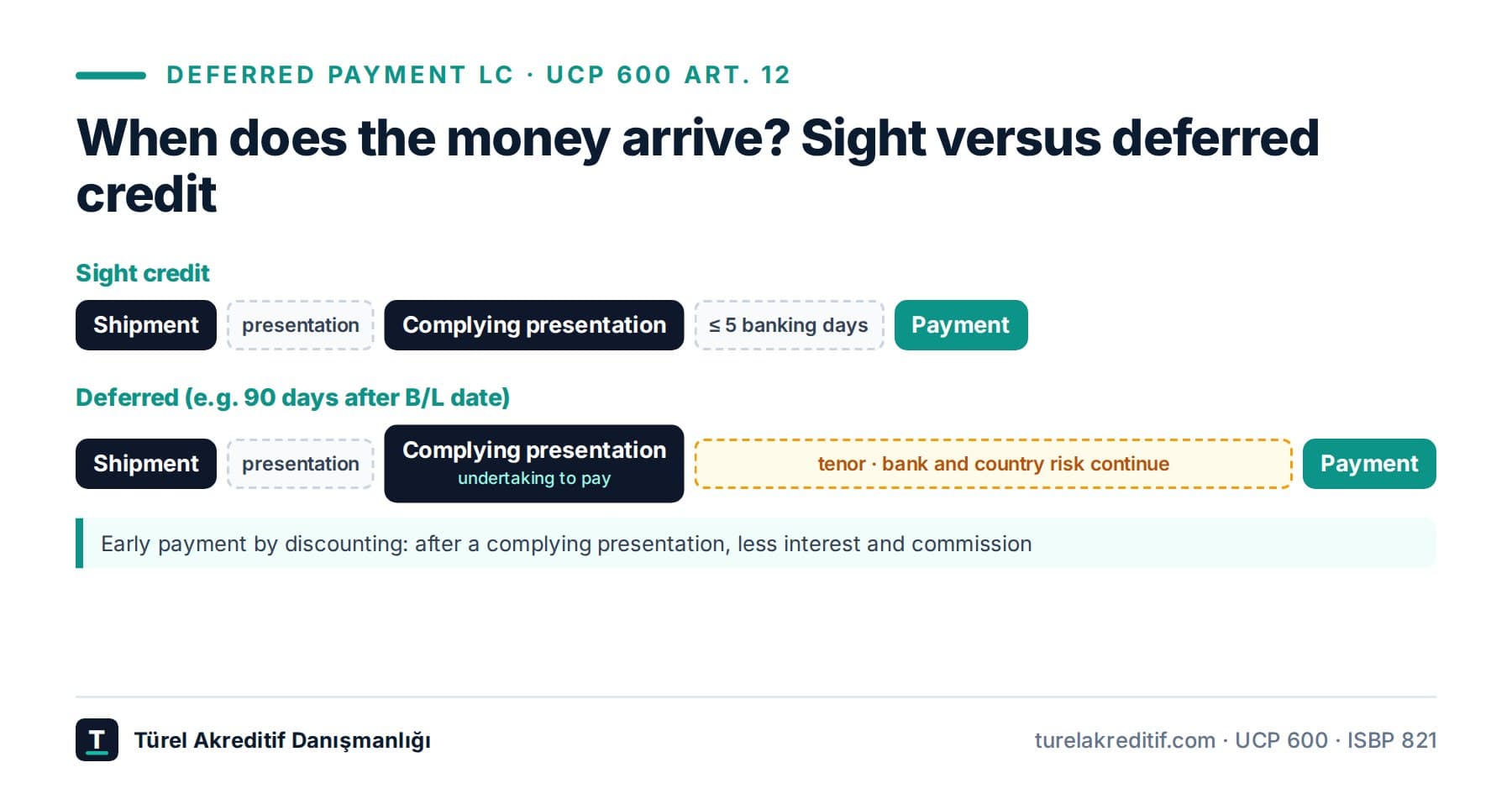
Sight versus deferred
Under a sight credit, once a complying presentation is made the bank examines the documents and pays. Examination takes at most five banking days (UCP 600 art. 14b).
Under a deferred credit, a complying presentation does not trigger payment but an undertaking to pay. The bank finds the documents compliant and confirms it will pay on a set date. The money arrives on that maturity date.
What matters: from the moment you make a complying presentation, the bank's obligation to pay is fixed. Whether the buyer manages to sell the goods before maturity does not change the bank's obligation.
Types of deferred credit
Field 41a shows how the credit is available. There are two main deferred structures:
- By deferred payment: no draft. The bank undertakes to pay at a set maturity, written in field 42P.
- By acceptance: the exporter draws a time draft, the bank accepts it and pays at maturity. The tenor is written in 42C as the draft tenor.
There are also deferred credits available by negotiation, where the nominated bank can purchase the documents and draft and pay you before maturity.
How the tenor is written
What the tenor is counted from matters as much as its length. Three common structures:
- From the bill of lading date (e.g. 90 days after B/L date): the clock starts on shipment. The most predictable option; a late presentation does not delay maturity.
- From presentation (e.g. 60 days after presentation): the clock starts when documents reach the bank. Present late and you are paid late.
- From the invoice date: less common; depends on when the invoice is issued.
Under UCP 600 article 3, when determining a maturity date, "from" and "after" exclude the date mentioned. In "90 days after B/L date", the bill of lading date itself is not counted.
A vague tenor leads to disputes over the calculation and to amendments. In our Libya case study, a tenor of "60 days after presentation" was later changed to 30 days by a separate amendment; with a clear text from the start, that round would never have been needed.
Getting paid before maturity: discounting
Once a complying presentation is made and the bank has confirmed its undertaking, you can turn that receivable into cash before maturity. This is called discounting.
Under UCP 600 article 12(b), nominating a bank to accept a draft or incur a deferred payment undertaking also authorises it to prepay or purchase that undertaking. In practice:
- A complying presentation is made and the bank confirms its undertaking.
- The exporter asks its bank to discount.
- The bank pays immediately, deducting interest and commission up to maturity.
The cost depends on the tenor, interest rates and the issuing bank's risk. With a weak issuing bank, a discount offer is hard to get or expensive. That is why deferred credits and confirmation often belong together. See confirmed letter of credit.
Note: discounting requires a complying presentation. With discrepant documents the bank gives no undertaking, and nothing can be discounted.
The exporter's risks
- Issuing bank risk stretches over time: something going wrong at the bank is unlikely over 30 days, much more likely over 180.
- Country risk: currency controls or transfer restrictions can appear during the term.
- Cash flow: you finance production and materials until maturity.
- Tenor drift: if the tenor runs "from presentation", every late document delays payment too.
Practical tips
- Where possible, tie the tenor to the bill of lading date.
- Settle the length and starting point of the tenor at draft stage; changing it after issuance means an amendment.
- Do not accept an unconfirmed deferred credit from a weak issuing bank.
- If you plan to discount, build the cost into your price.
- Look at the charges at the same time; see letter of credit charges.
Summary
- Under a deferred credit, a complying presentation creates a firm undertaking to pay, not immediate payment.
- Two main types: deferred payment and acceptance.
- Whether the tenor runs from the B/L date or from presentation directly affects cash flow.
- Discounting brings payment forward, but only after a complying presentation.
- A long tenor plus a weak bank calls for confirmation.
Is your buyer asking for a deferred credit? Ask for a free preliminary review and see the tenor structure and risk before you accept.