
Lists of "letter of credit types" usually stack fifteen or twenty terms on top of each other and leave the reader more confused. Yet most types are not alternatives to each other: the same credit can be irrevocable, confirmed, deferred and transferable all at once.
The easy way to understand them is to group them by four questions:
- Who gives the security?
- When does the money arrive?
- How is the credit structured?
- Does it have a special purpose?
If you are new to how a credit works, start with what is a letter of credit.
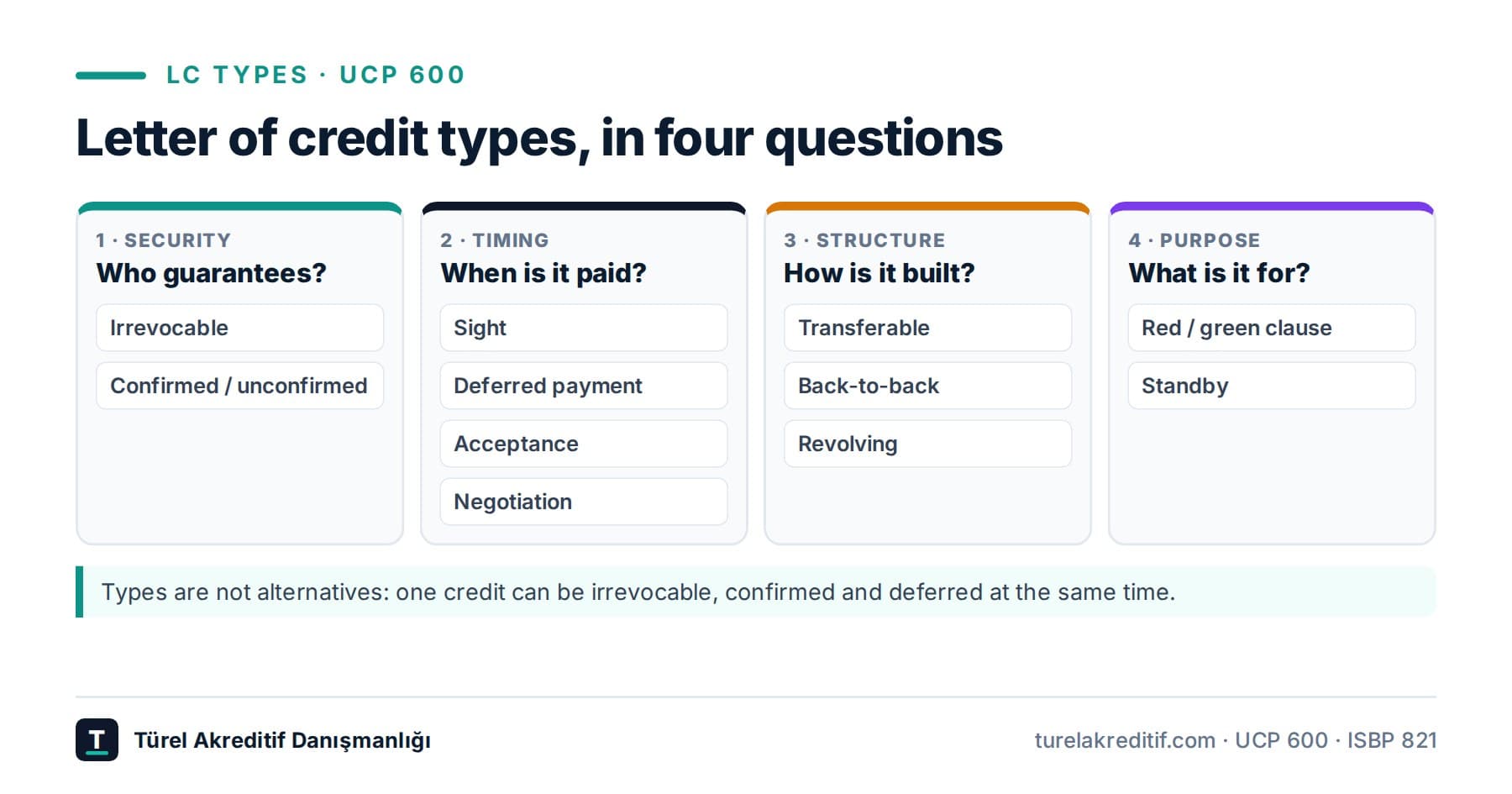
1. By security
Irrevocable letter of credit
The issuing bank cannot amend or cancel the credit without the beneficiary's (the exporter's) consent. Under UCP 600, a credit is irrevocable even if the text does not say so (art. 3). "Revocable" credits are therefore practically unused today; real security for the exporter only comes with an irrevocable credit.
Confirmed and unconfirmed letters of credit
In a confirmed credit, a second bank gives its own undertaking to pay, independently of the issuing bank (UCP 600 art. 8). When the issuing bank or its country is risky, that second undertaking is often what actually secures payment. In an unconfirmed credit, the bank in the exporter's country is usually only the advising bank and gives no undertaking.
More: confirmed letter of credit: what it is and when you need one
2. By timing of payment
How a credit is available is stated in field 41a. Under UCP 600 article 6 there are four ways:
Sight payment
On a complying presentation, the bank examines the documents and pays. Examination takes at most five banking days. The best structure for the exporter's cash flow.
Deferred payment
A complying presentation creates an undertaking to pay on a set date, not immediate payment. The tenor usually runs from the bill of lading date or from presentation (e.g. 90 days).
Acceptance
The exporter draws a time draft, the bank accepts it and pays at maturity. An accepted draft can be discounted to get the money early. Much of the search interest in "LC financing" is really about this structure and discounting.
Negotiation
The nominated bank can purchase the complying documents (and any draft), paying the exporter before the issuing bank reimburses. "Available with any bank by negotiation" gives the exporter the flexibility to present to its own bank.
We cover the cash-flow and discounting side of deferred structures in deferred payment letter of credit.
3. By structure
Transferable letter of credit
The first beneficiary can transfer the credit, in whole or in part, to a second beneficiary (usually the actual manufacturer). Useful for intermediaries and trading companies. The rules are in UCP 600 article 38: a credit can only be transferred if it is expressly designated "transferable", and as a rule it can be transferred only once.
Back-to-back letter of credit
The intermediary uses the credit opened in its favour as security to have its own bank issue a second, separate credit in favour of its supplier. The two credits are legally independent. It is used when a transferable credit is not available, but it needs more care because the two texts must be built to match each other exactly.
Revolving letter of credit
For regular, repeated shipments to the same buyer: instead of opening a new credit for each shipment, a single credit is used whose amount is reinstated periodically or as it is drawn. The credit must state clearly whether unused amounts carry over to the next period (cumulative or non-cumulative).
4. Special-purpose types
Red clause letter of credit
A clause allowing part of the credit amount to be advanced to the exporter before shipment, to finance production or raw materials. The name comes from the clause once being written in red ink. A variant, the green clause, ties the advance to a document showing the goods have been warehoused.
Standby letter of credit
Not a means of paying for goods like a classic credit, but a security: the buyer pays by other means (for example open account), and if it does not, the seller draws on the standby. It is usually issued subject to ISP98, sometimes to UCP 600. In function it is close to a bank guarantee.
Letters of credit and financing: two sides, two meanings
Behind searches for "letter of credit financing" there are usually two different needs:
- For the importer: the bank sets up a non-cash credit line to open the credit. In other words, having a credit opened requires a facility with your bank.
- For the exporter: under a deferred or acceptance credit, the receivable that arises after a complying presentation can be discounted for early cash. A red clause credit provides pre-shipment finance.
The key point for the exporter: financing depends on the type of credit and on a complying presentation. With discrepant documents, the bank gives no undertaking and discounts nothing.
Which type is right for you?
- Is the buyer's bank risky? Ask for a confirmed credit.
- Do you need the cash? Ask for sight payment; if a tenor is unavoidable, price in discounting.
- Are you an intermediary? A transferable credit; failing that, back-to-back.
- Selling regularly to the same buyer? A revolving credit cuts issuance and amendment costs.
- Need production finance? Negotiate a red clause.
Whatever the type, the rest of the text must protect you too. We listed what to check before accepting in our LC draft checklist. For the rules, see UCP 600 explained.
Summary
- LC types are not alternatives; one credit can be several types at once.
- Under UCP 600, every credit is irrevocable.
- Confirmation decides security, the availability decides cash flow, transferability serves intermediaries.
- "LC financing" means discounting and red clauses for exporters, and a credit line for importers.
- Financing depends on a complying presentation.
To work out which type fits your deal at text stage, take a look at our LC text review.
Unsure about the type of credit your buyer is proposing? Send the text for a free preliminary review.