
Near the bottom of almost every letter of credit you will find the same line: "This credit is subject to UCP 600." Most exporters read past it. Yet that line decides how the bank will look at your documents, how long it may take to examine them, which mistakes count as a discrepancy and which are ignored.
In short, whether you get paid under an LC depends heavily on a handful of UCP 600 articles.
What is UCP 600?
UCP 600 (Uniform Customs and Practice for Documentary Credits) is the set of rules for letters of credit published by the International Chamber of Commerce (ICC). It came into force on 1 July 2007 as ICC Publication No. 600 and contains 39 articles.
It is not law; it is a set of contractual rules. It becomes binding when the credit expressly states that it is subject to it (article 1). Almost every documentary credit issued today is, which is why an issuing bank in North Africa and an advising bank in Europe look at the same document through the same lens.
Two companion publications sit next to UCP 600:
- ISBP 821: International Standard Banking Practice for the examination of documents (2023 revision). It does not change UCP 600; it explains how its articles are applied in practice.
- eUCP 2.1: A supplement to UCP 600 for credits that allow electronic presentation, in whole or in part.
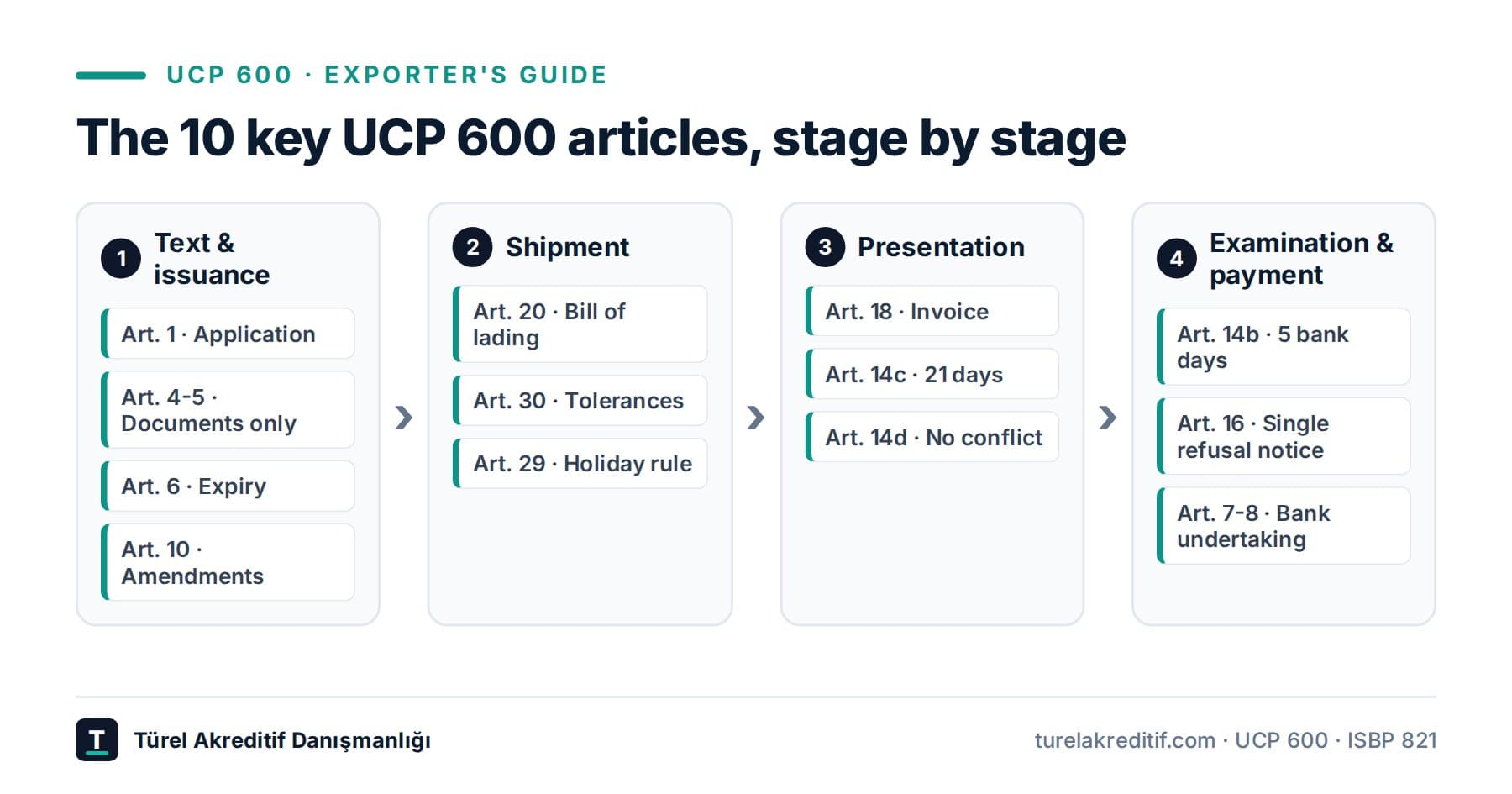
The 10 articles every exporter should know
1. Articles 4 and 5: banks deal with documents, not goods
A credit is independent of the sales contract between you and your buyer (art. 4). Banks deal with documents, not with goods, services or performance (art. 5).
In practice: your goods may be perfect and your buyer happy, but if the documents contain a discrepancy, the bank can refuse to pay. Conversely, if the documents comply, a buyer's complaint about the goods does not, on its own, release the bank from its obligation.
2. Article 6: expiry date and place for presentation
Every credit must state an expiry date and a place for presentation. Documents must be presented by that date, at that place or with the nominated bank. If the place of expiry is the buyer's country, your documents must arrive there before the expiry date; courier time is your problem.
3. Articles 7 and 8: the undertakings of the issuing and confirming bank
When a complying presentation is made, the issuing bank must honour (art. 7). If the credit is confirmed, the confirming bank takes on the same obligation, independently of the issuing bank (art. 8). With a weak issuing bank, this second undertaking is often what actually secures payment. We cover it in detail in our article on confirmed letters of credit.
4. Article 10: no amendment without your consent
A credit cannot be amended or cancelled without the agreement of the issuing bank, the confirming bank (if any) and the beneficiary (you). Partial acceptance of an amendment is not allowed and counts as rejection. A clause saying an amendment takes effect "unless rejected within a certain time" is disregarded.
This is real leverage for the exporter: you are not obliged to accept a change that works against you.
5. Article 14: the standard for examination
The heart of UCP 600. It sets how banks examine documents:
- Banks have a maximum of five banking days following the day of presentation to examine documents (14b).
- Data in documents need not be identical, but must not conflict (14d).
- Outside the commercial invoice, the goods may be described in general terms, as long as they do not conflict with the credit (14e).
- A presentation including original transport documents must be made no later than 21 calendar days after the date of shipment, and never after the expiry date (14c).
- A condition that does not name a document to show compliance (for example "goods must be of EU origin") is deemed not stated and disregarded (14h).
6. Article 16: one refusal notice
If a bank decides the presentation does not comply, it must list all discrepancies in a single notice, no later than the fifth banking day following presentation. A bank that fails to do so cannot later claim the documents were non-compliant. In a discrepant presentation, the timing and content of that notice can change the outcome.
7. Article 18: commercial invoice
The invoice must be issued by the beneficiary, made out in the name of the applicant (the buyer) and in the same currency as the credit. It need not be signed. Most importantly, the description of goods must correspond with the description in the credit. A large share of discrepancies start here.
8. Article 20: bill of lading
The bill of lading must name the carrier, be signed by the carrier or master (or a named agent for either), and show that the goods were shipped on board. Unless it carries a dated on-board notation, its date of issuance is deemed the date of shipment. That date starts both the latest-shipment check and the 21-day presentation period.
9. Article 29: bank holidays
If the expiry date or the last day for presentation falls on a day the bank is closed, it is extended to the first following banking day. The latest date for shipment is not extended. Many exporters learn this difference during a public holiday.
10. Article 30: tolerances
Where "about" or "approximately" is used before the amount, quantity or unit price, a 10% tolerance applies. Where the goods are not stated in packing units or individual items (tons, metres) and total drawings do not exceed the credit amount, a 5% tolerance in quantity is allowed. For bulk cargo, this article prevents a discrepancy over a few extra tons.
Is reading the rulebook enough?
No. UCP 600 tells you what the rule is; ISBP 821 and banking practice decide how it applies in a given case. The same text can raise different questions at two different banks. The hard part is not knowing the rule, it is applying it to your credit and your documents.
The most effective approach is to see where UCP 600 protects you while the credit is still a draft, and to fix the points where it will hurt you before you accept. That is exactly what our LC text review does. Before accepting a draft, run it through our 12-question LC draft checklist.
Summary
- UCP 600 is the ICC's 39-article rulebook for letters of credit; it binds when the credit says so.
- Banks deal with documents, not goods. Documents need not be identical but must not conflict.
- Examination takes at most five banking days; presentation with transport documents is due within 21 days of shipment unless the credit says otherwise.
- No amendment is effective without your consent.
- The latest shipment date is never extended for holidays.
Do you have a credit subject to UCP 600 in your favour? Send it for a free preliminary review and see the risky clauses before you accept.