
In export, there is a negotiation as important as price: when will the money arrive, and with what security? Choosing a payment method is really answering one question: in the gap between goods and money, who carries the risk?
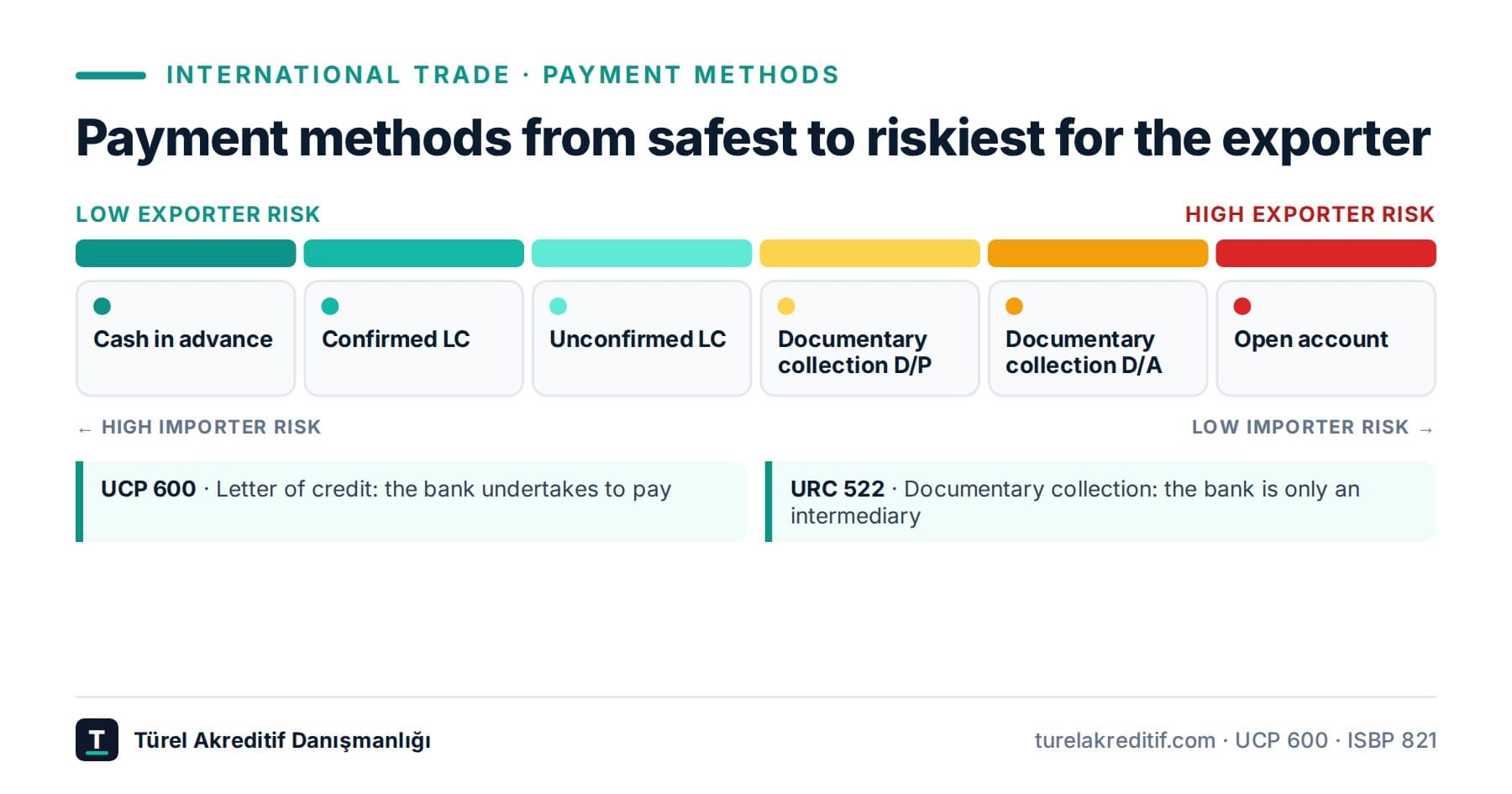
International trade has four main payment methods. Put them on one scale and the picture becomes clear: what is safest for the exporter is riskiest for the importer, and the other way round.
1. Cash in advance
The buyer pays before the goods are shipped. For the exporter the risk is close to zero; all of it sits with the buyer.
When it makes sense: custom-made products, new and unknown buyers, small amounts, or when the seller has strong bargaining power.
The problem: in competitive markets buyers refuse it. Insisting on full prepayment often means losing the order. In practice a common structure is partial advance plus another method for the balance (for example 30% in advance, 70% by letter of credit or documentary collection).
2. Open account
Goods are shipped, documents go directly to the buyer, and the buyer pays after receiving the goods (often on agreed terms). No bank gives any undertaking to pay.
When it makes sense: long-standing, reliable buyers with a clean payment record; markets where legal enforcement works; when backed by export credit insurance.
The problem: all the risk is with the exporter. If the buyer does not pay, you are left with an invoice and a long legal process. The goods are already in the buyer's hands.
3. Documentary collection
Documents representing the goods (especially the bill of lading) are sent to the buyer through banks. The buyer can only take the documents after paying or accepting a bill of exchange. The international rules are ICC's URC 522.
There are two forms:
- Documents against payment (D/P): the buyer pays, then receives the documents.
- Documents against acceptance (D/A): the buyer accepts a time draft, receives the documents and pays at maturity.
When it makes sense: known buyers where full trust is not yet built, and mid-size amounts where the cost of a letter of credit would be high relative to the deal.
The problem: banks act only as intermediaries and give no undertaking to pay. If the buyer walks away from the documents, your goods sit in a foreign port. Demurrage and storage start to run, and the goods are either sold cheaply or shipped back at your cost. D/A is riskier still: the buyer has the goods and you hold only an accepted draft.
4. Letter of credit
The buyer's bank undertakes to pay when specified documents are presented in compliance with the credit's terms. The rules are ICC's UCP 600; see UCP 600 explained.
When it makes sense: new buyers, large amounts, high-risk markets, and situations where the buyer will not pay in advance but the seller cannot take open-account risk.
Two important limits:
- The security is conditional: if the documents do not comply, the bank does not pay. With a letter of credit, much of the risk moves from the goods to the paperwork.
- The security is only as strong as the bank: if the issuing bank is weak, you need confirmation. See confirmed letter of credit.
Decision guide: which method for which buyer?
From safest to riskiest for the exporter:
- Cash in advance
- Confirmed letter of credit
- Unconfirmed letter of credit
- Documentary collection, D/P
- Documentary collection, D/A
- Open account
A practical sequence:
- Don't know the buyer? Advance payment, partial advance or a letter of credit.
- Currency controls, transfer problems or political risk in the buyer's country? Confirmed letter of credit. Documentary collection is a serious risk here.
- Is the amount more than you could afford to lose? Letter of credit, or a structure backed by credit insurance.
- A buyer you have worked with for years, in a strong market? Documentary collection or open account can be reasonable.
The "LCs are too complicated, let's do a collection" trap
Many small exporters avoid letters of credit because of the document discipline they require and turn to methods that look simpler. Understandable, but in high-risk markets that simplicity is paid for in delayed payments, and sometimes in receivables that are never collected.
The complexity of a letter of credit is manageable: with a well-built credit and properly prepared documents, it is the most predictable way to work with a risky buyer. We collected what to check before accepting a credit in our LC draft checklist.
Summary
- Choosing a payment method is deciding who carries the risk between goods and money.
- Cash in advance is safest for the exporter, open account the riskiest.
- In documentary collection (URC 522), banks are intermediaries and do not undertake to pay.
- In a letter of credit (UCP 600), the bank undertakes to pay, as long as the documents comply.
- In high-risk markets the right choice is often a confirmed letter of credit.
Not sure which method suits a new buyer or a risky market? Write to us and we will look at your specific deal.