
"Letters of credit are expensive" is a common line in trade. But the real problem is less the level of the charges than how unpredictable they are. The exporter builds the issuance fee into the quote, but does not expect the advising, confirmation, amendment and discrepancy deductions that come off the proceeds on payment day.
The way to understand LC charges is to split them by stage and check, in the credit itself, who each one is allocated to.
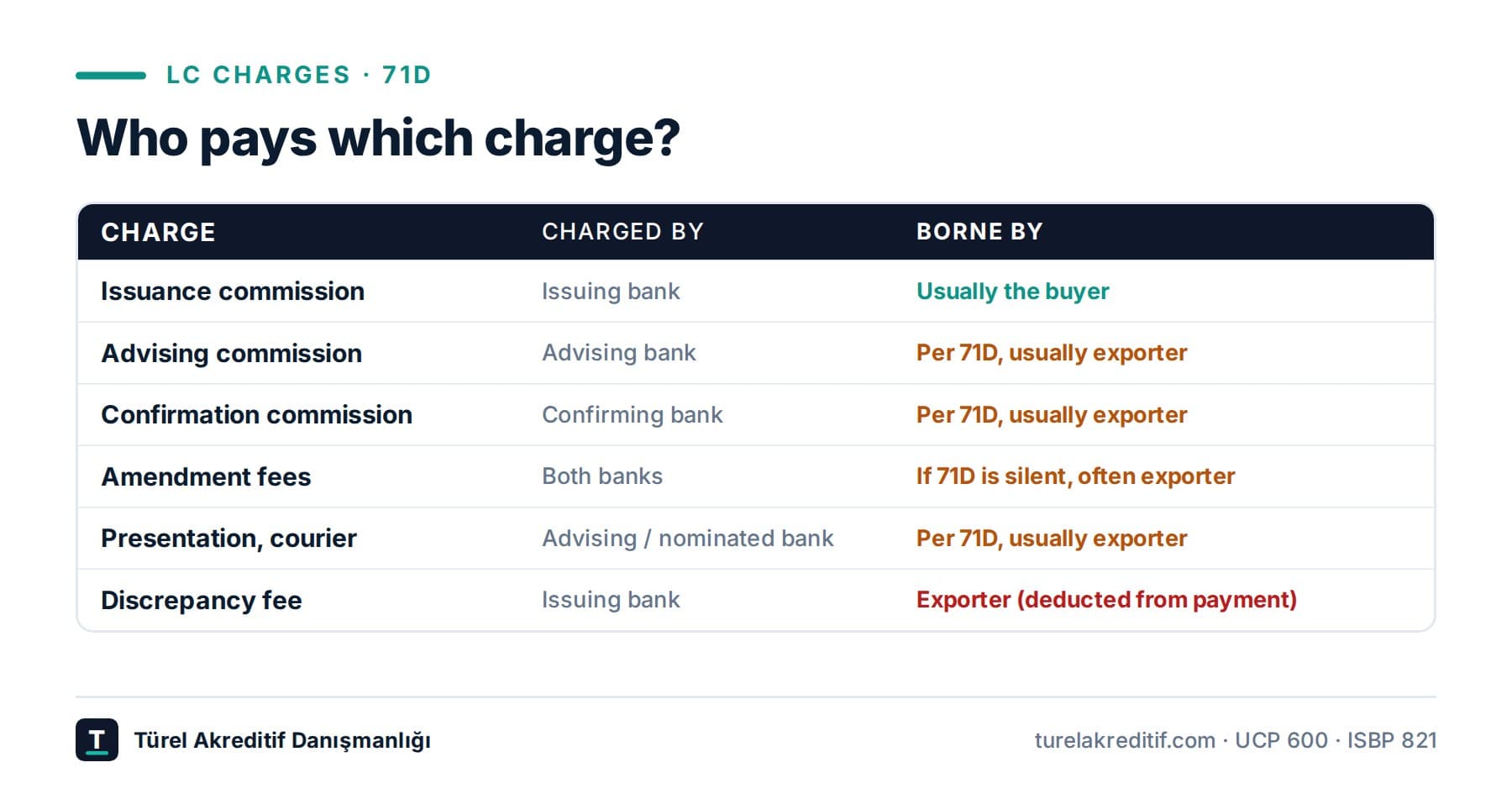
The charge items
Charges arising in the buyer's country
- Issuance commission: what the issuing bank charges to open the credit, based on amount and tenor. Usually paid by the buyer.
- Amendment fees (issuing bank): charged each time the credit is changed.
- Payment and transfer charges: deducted when payment is made and remitted.
Charges arising in the exporter's country
- Advising commission: for the local bank authenticating the credit and passing it on to you.
- Confirmation commission: if confirmation is added, the confirming bank's fee for taking the risk. It varies sharply with the issuing bank and country. See confirmed letter of credit.
- Amendment advising fee: for passing each amendment on to you.
- Presentation / document examination fee: for checking documents and sending them to the issuing bank.
- Courier charges: for sending original documents abroad.
- Local taxes on bank fees: in some countries (Turkey's BSMV, for example) a tax is added on top of bank commissions.
Surprise charges
- Discrepancy fee: the issuing bank often deducts a fixed fee for discrepant documents directly from the payment. It appears in the credit as a "discrepancy fee".
- Discounting cost: if you want the money before maturity under a deferred-payment credit, you pay interest. See deferred payment letter of credit.
Field 71D: who pays what
In the SWIFT MT700, field 71D (Charges) states which party bears which charges. The most common wording is:
"All banking charges outside the issuing bank's country are for the account of the beneficiary."
This means all charges outside the issuing bank's country (advising, confirmation, amendment advising, presentation, courier) are yours.
If the credit says nothing about charges, UCP 600 article 37(c) makes a bank that instructs another bank responsible for that bank's charges, so the chain of charges in principle runs back to the buyer's side. In practice, though, the great majority of credits include the sentence above and so put the charges on you explicitly. Accepting a credit without reading 71D means accepting its charges too.
One more point: if the credit does not deal with amendment charges separately, banks often pass them on to you as foreign charges. Even an amendment the buyer requests to fix its own mistake can end up deducted from your proceeds. Adding wording such as "amendment charges are for the account of the party requesting the amendment" reduces this risk.
How to reduce the charges
1. Build them into the price from the start
Before quoting, ask your bank for an approximate total of advising, confirmation and presentation charges for that deal. If it is not in your price, it comes out of your margin.
2. Negotiate 71D at draft stage
Ask for confirmation charges to be for the buyer's account, or for a "each party pays charges in its own country" structure, while the credit is still a draft. On an issued credit, that change means another amendment.
3. Keep amendments to a minimum
Every amendment means separate fees at two banks, extra correspondence and lost time. In our Libya case study, one free-format correction and three amendments were needed in the three months after issuance, all around the same two issues (the certificate of origin and the payment term). They could have been solved in one round at draft stage.
4. Prevent discrepancies
The discrepancy fee is the most avoidable charge that comes straight out of your profit. Worse, a discrepancy gives the buyer an opening to ask for a price reduction. We listed the most common causes in the 10 most common LC discrepancies.
5. Use confirmation where it is really needed
With a strong issuing bank, confirmation is an unnecessary cost; with a weak one, it is essential. Decide based on bank and country risk, not habit.
Summary
- LC charges are not just the issuance fee: advising, confirmation, amendment, presentation, courier and discrepancy charges add up.
- Field 71D decides who pays; the most common wording puts foreign charges on the exporter.
- Price the charges in from the start and negotiate 71D at draft stage.
- Amendments and discrepancies are the easiest charges to avoid.
If you want to see the charge structure and amendment risk together before accepting a credit, take a look at our LC text review.
Unsure about the charges in a credit being opened in your favour? Send the text for a free preliminary review.