
The least forgiving mistakes under a letter of credit are about time. A mismatch in the goods description can sometimes be waived by the buyer. But once a credit has expired, the bank's obligation to pay is over; from that point everything depends on the buyer's goodwill.
Every credit has three critical dates. They are linked, and each has its own rule in UCP 600.
1. Latest date of shipment (44C)
The latest date by which the goods must be shipped. For sea freight, the date of shipment is the issue date of the bill of lading; if the bill carries a separate dated on-board notation, that date applies instead (UCP 600 art. 20).
Points to watch:
- The latest shipment date is not extended even if it falls on a day the banks are closed (art. 29c).
- If the vessel is late or the container misses the cut-off, that is your problem. Plan for a few days before the last date, not the last day itself.
- If there is no latest shipment date, the expiry date becomes the effective limit, but you still need to allow for the presentation period.
2. Period for presentation (48)
How many days you have after shipment to present documents to the bank. If the credit is silent, UCP 600 article 14(c) applies: a presentation including original transport documents must be made no later than 21 calendar days after the date of shipment.
Those 21 days have another limit: never later than the expiry date.
The most common problem in practice is a presentation period that is too short. A condition such as "documents must be presented within 7 days after shipment" may not be enough when the carrier issues the bill of lading late, the certificate of origin is held up for certification, or documents have to come from another city. Negotiate this period against the reality of your document preparation at draft stage.
3. Expiry date and place (31D)
The latest date by which, and the place where, documents must be presented (art. 6). The point most often missed is the place.
- If the place of expiry is your country, presenting to the nominated bank there by that date is enough.
- If it is the buyer's country, the documents must arrive at the bank abroad by that date. Courier time comes out of your time.
If the expiry date falls on a day the bank is closed for reasons other than those in UCP 600 article 36 (for example a public holiday), it is extended to the first following banking day (art. 29a). But if a credit expires while a bank is closed because of force majeure, the bank will not honour it when it reopens (art. 36).
How the three dates work together: an example
Say a credit states:
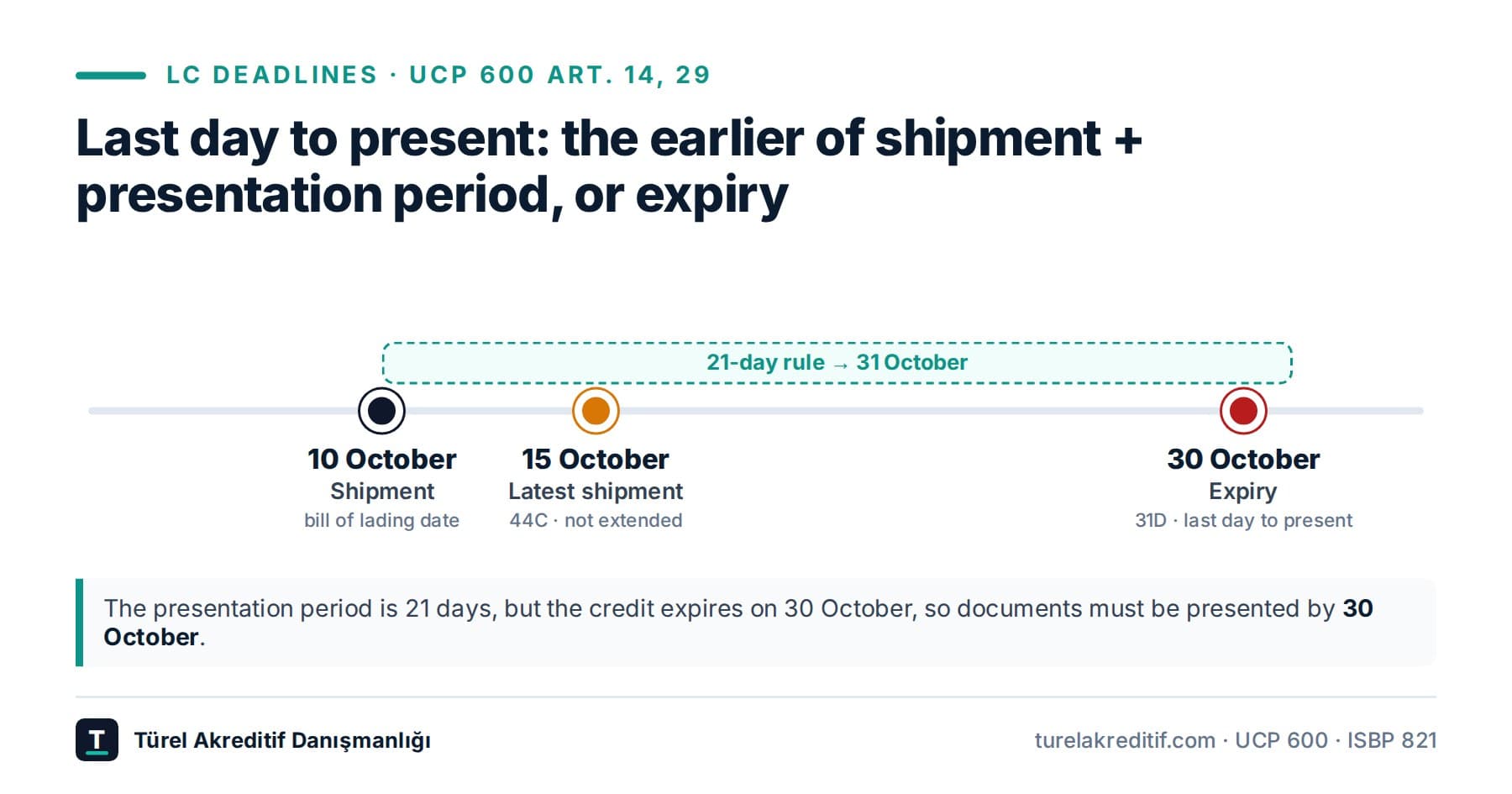
- Latest shipment date: 15 October
- Presentation period: not stated (so 21 days)
- Expiry date: 30 October, in the exporter's country
You ship on 10 October. What is the last day to present?
- Under the 21-day rule: 31 October.
- Under the expiry date: 30 October.
Whichever comes first applies: 30 October. You cannot use all 21 days.
Now say you ship on 15 October. The 21-day rule points to 5 November, but the credit expires on 30 October. Your presentation period has effectively shrunk to 15 days. If your documents take longer than that to prepare, shipping on the last possible day puts you at risk.
A simple rule: last day to present = the earlier of (shipment date + presentation period) and the expiry date.
What the date words mean (art. 3)
UCP 600 also defines the date expressions used in credits:
- "On or about" covers five calendar days before until five calendar days after the date, both included.
- "To", "until", "till", "from", "between" used for a shipment period include the date mentioned.
- "Before" and "after" exclude the date mentioned.
- When determining a maturity date, "from" and "after" exclude the date mentioned.
- "First half" and "second half" of a month mean the 1st–15th and 16th–last day; "beginning", "middle", "end" mean the 1st–10th, 11th–20th and 21st–last day.
Under "shipment before 15 October", shipping on 15 October is late.
The bank's examination time is a deadline too
After presentation, the bank has at most five banking days to examine the documents (art. 14b). If it finds discrepancies, it must give all of them in a single notice within that time (art. 16). That is a timetable for you as well: if a refusal notice comes and the presentation period and expiry date have not yet passed, you may still be able to re-present corrected documents. Not leaving documents to the last day protects not only against lateness but also your chance to correct.
Practical tips
- Before accepting the credit, work backwards from production, freight and document preparation times.
- Ask for the place of expiry to be in your own country.
- If the presentation period is shorter than 21 days, check that your documents really can be ready in time.
- Remember that the latest shipment date is not extended over holidays.
- Don't leave documents to the last day; keep room for corrections.
- If you need an extension, request the amendment before shipment.
Checking all documents against the credit before presentation keeps discrepancy risk to a minimum. Our pre-presentation document check manages this timetable for you. For the rules behind these dates, see UCP 600 explained.
Summary
- Three critical dates: latest shipment (44C), presentation period (48), expiry date and place (31D).
- If no presentation period is stated, it is 21 days after shipment, but never beyond expiry.
- The expiry date is extended over a holiday; the latest shipment date is not.
- If expiry is abroad, documents must arrive there in time.
- "Before" and "after" exclude the date mentioned.
Do the dates in your credit fit your production and shipping plan? Ask for a free preliminary review before you ship.